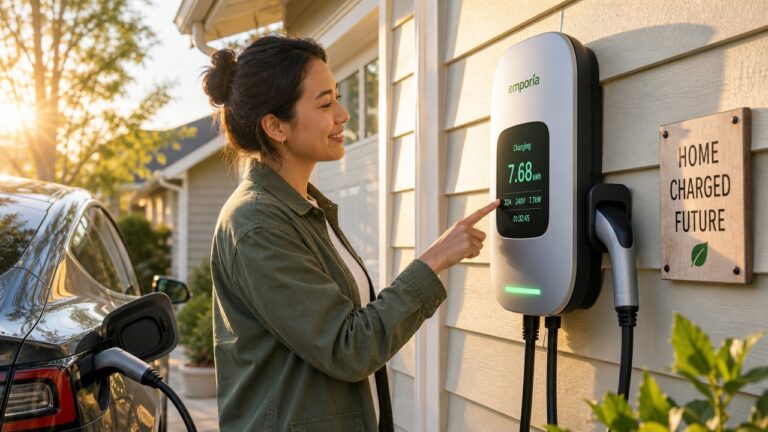
To calculate your home EV charging cost, multiply your utility’s price per kWh by your vehicle’s battery capacity. Remember to add both supply and delivery fees for an accurate rate. You should also account for a 15% energy loss from heat during the charging process. If you switch to a time-of-use plan, you’ll likely save money by charging overnight. Following these steps guarantees your monthly estimates stay precise as you explore further.
Key Takeaways
- Identify your total utility rate by adding the supply charge, delivery fees, and taxes found on your latest electric bill.
- Account for 10%–15% energy loss during charging by dividing the battery’s capacity by an efficiency factor like 0.88.
- Multiply your vehicle’s usable battery capacity by your utility rate to determine the estimated cost for a single full charge.
- Calculate monthly expenses by multiplying your total miles driven by your vehicle’s kilowatt-hour consumption per mile.
- Lower your costs by charging during off-peak hours if your utility provider offers a Time-of-Use (TOU) rate plan.
Find the Price per kWh on Your Utility Bill
Locating the price per kilowatt-hour (kWh) on your monthly utility statement is the first step in calculating your home EV charging expenses. You’ll usually find this specific metric within the “Detailed Charges” or “Supply Services” section of the document. Look closely at the line items labeled “energy charge” or “usage rate.” If your provider breaks down costs into supply and delivery categories, you must add these individual rates together to determine your total effective price. Don’t ignore fixed monthly service fees; while they remain constant regardless of usage, the volumetric rate fluctuates based on your consumption.
Check if you’re currently on a time-of-use (TOU) plan. These arrangements offer cheaper rates during overnight hours when the grid experiences less demand. Since you’ll likely charge your vehicle while you sleep, knowing your off-peak rate guarantees you get the most accurate data. Always verify the current billing cycle’s rate before performing any math.
Calculate Your EV Charging Cost Using This Formula
You’ll first need to identify your charger’s power rate and the specific utility price from your latest bill.
Once you’ve gathered these two figures, apply a basic math formula to see exactly what a full charge costs you. This simple calculation clears up any confusion about your monthly energy consumption and keeps your budget on track.
Identify Charging Power Rate
Pinpointing your charger’s power rate is the first step toward calculating precise home charging expenses. You’ll measure this output in kilowatts (kW), representing the speed at which electricity flows into your battery. If you’re using a standard wall outlet, you’re likely pulling 1.4 kW. However, a dedicated Level 2 station typically delivers between 7.6 kW and 19.2 kW. Check your unit’s technical specifications or your vehicle’s dashboard display during a session to find this number. Understanding this variable helps you predict how long your car stays plugged in to reach a full charge.
Consider these factors when identifying your rate:
- The maximum intake capacity of your EV’s onboard charger.
- The circuit breaker’s amperage rating in your electrical panel.
- The specific output settings configured on your smart charging station.
Determine Utility Price Input
How much does your utility provider actually charge for each kilowatt-hour of electricity? You’ll find this figure on your monthly energy bill, usually listed as the “energy charge” or “supply rate.” Don’t just look at the base rate, though; you need to include local taxes and distribution fees for a true total.
Check if you’re on a time-of-use plan. These plans vary your price depending on when you plug in. If you charge during off-peak hours, you’ll likely pay a markedly lower rate than during the day. Locate your specific cents-per-kWh rate for the exact time window you intend to power your vehicle.
Identifying this precise number guarantees your estimate reflects reality rather than a guess. Grab your most recent statement and pinpoint that final cost per unit now.
Apply Basic Math Formula
Once you’ve identified your specific utility rate, you can plug that number into a simple equation to find the price of a full charge. Take your vehicle’s usable battery capacity in kilowatt-hours and multiply it by your electricity rate. For instance, if you’re charging an 80 kWh battery at $0.15 per kWh, you’ll spend $12.00 for a total fill-up.
It’s a straightforward calculation that strips away the mystery of your monthly energy bill. Understanding this formula empowers you to manage your budget effectively while maximizing your car’s efficiency.
- Multiply total battery capacity by your current cost per kWh.
- Account for charging losses, which typically add 10% to the final tally.
- Compare this figure to gasoline prices to visualize your massive long-term savings.
Adjust for Charging Efficiency Losses in Your Total
You can’t assume every kilowatt-hour from your outlet reaches the battery because you’ll lose significant energy to heat dissipation during the transfer.
You must factor in your charging equipment’s inherent efficiency ratings to guarantee your cost estimates stay accurate.
Don’t overlook these losses, or you’ll consistently underestimate your monthly electric bill.
Account For Heat Dissipation
While it’s easy to assume every kilowatt-hour drawn from the wall ends up in your battery, you shouldn’t ignore the energy lost to heat during the conversion process. When you charge, the onboard charger transforms AC power into DC power. This chemical and electrical reaction generates significant warmth, bleeding off energy before it ever stores a mile of range. If your garage feels warmer after a session, you’re literally feeling your money vanish into thin air. You’ll typically pay for 10% to 15% more electricity than your car actually receives.
- Thermal management systems consume extra power to cool the battery.
- Resistance in internal cabling creates invisible energy leaks.
- Ambient temperatures dictate how much energy wastes away as heat.
Track these invisible costs to make sure your per-mile math stays accurate.
Factor In Equipment Efficiency
Since most Level 2 chargers operate between 85% and 90% efficiency, you can’t simply rely on the car’s reported battery intake to calculate your bill. Your electric meter measures every kilowatt-hour leaving the grid, not just what reaches the battery. To find your true cost, you’ll need to account for the energy lost during the AC-to-DC conversion process.
Don’t assume a 50 kWh charge costs exactly 50 times your utility rate. Instead, divide that 50 kWh by an efficiency factor like 0.88. This adjustment reveals you actually paid for roughly 56.8 kWh. By factoring in these equipment losses, you’ll avoid underestimating your monthly expenses. Precise tracking guarantees your budget stays accurate while you enjoy the savings of driving electric. Always include these overhead losses in your final math.
Compare Flat-Rate vs. Time-of-Use EV Charging Costs
Although standard flat-rate plans offer predictable pricing regardless of the hour, switching to a time-of-use (TOU) schedule often slashes your monthly bill.
You’re currently paying the same rate at noon as you do at midnight, which ignores the heavy demand on the power grid.
By shifting to TOU, you capitalize on lower demand periods when utilities drop their prices.
You’ll simply plug in your vehicle during “off-peak” hours—typically late at night—to secure the lowest possible cost per kWh.
If you stick with a flat rate, you’re fundamentally paying a premium for the convenience of ignoring the clock.
Consider these factors when choosing:
- Peak Multipliers: On-peak rates can double or triple your standard cost per kWh during summer afternoons.
- Super Off-Peak Windows: Some utilities offer ultra-low rates between 11 p.m. and 6 a.m. specifically for EV owners.
- Lifestyle Alignment: If you can’t delay charging, stay with flat-rate pricing.
Estimate Monthly EV Charging Costs Based on Mileage
Calculating your monthly expenditure requires matching your driving habits with your vehicle’s efficiency and your local utility rate.
First, determine how many miles you drive each month. Next, find your EV’s efficiency rating, typically expressed as kilowatt-hours (kWh) consumed per 100 miles. If your car uses 30 kWh per 100 miles and you travel 1,000 miles monthly, you’ll consume 300 kWh.
Multiply this total energy consumption by your specific cost per kWh. If you’re paying $0.15 per kWh, your monthly fuel bill totals $45.
Don’t forget that extreme weather or aggressive driving styles can lower your efficiency, increasing these totals slightly. Tracking your odometer helps you refine these projections over time.
Budget for Your Level 2 Home Station Installation
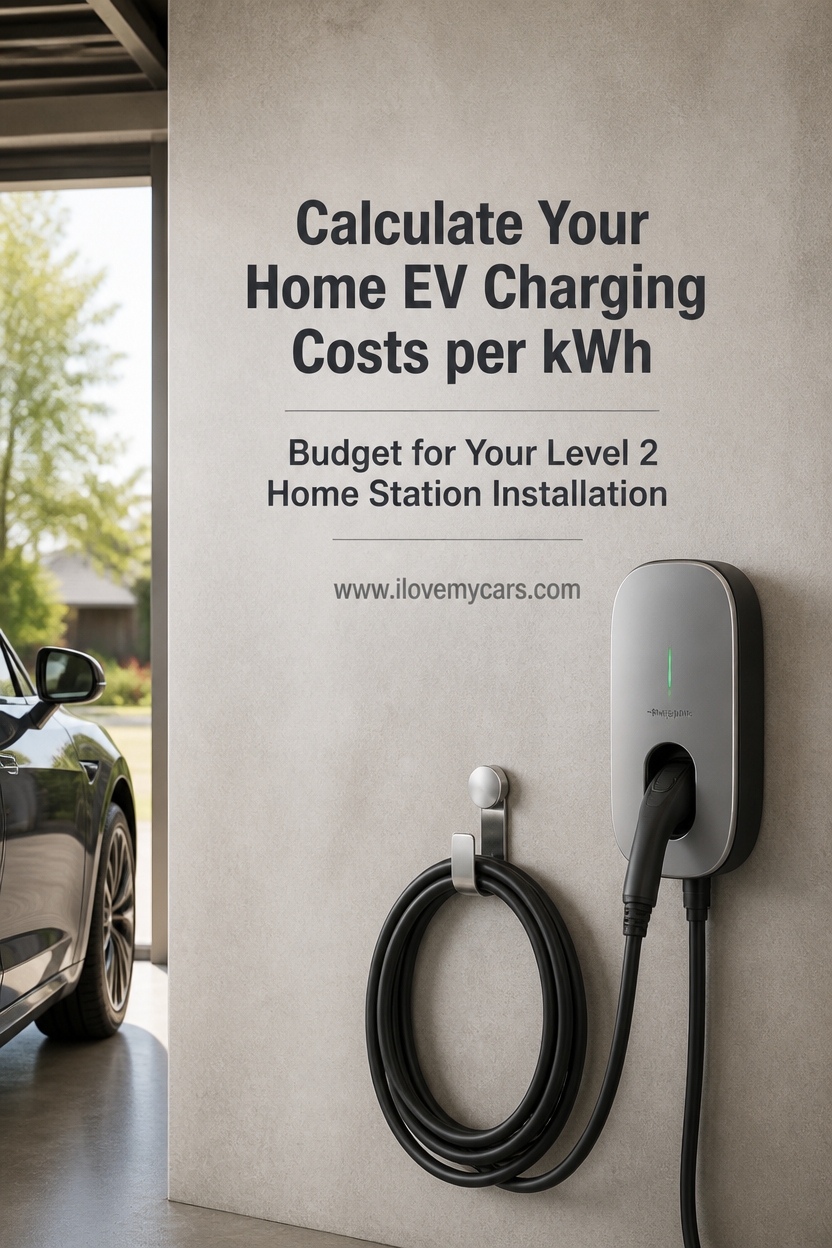
Shifting to a Level 2 home charging station requires planning for both equipment costs and professional labor fees. While a standard outlet works for overnight top-offs, you’ll likely want the 240-volt power a dedicated station provides. Typically, you’ll spend between $400 and $800 on the charging unit itself. However, the installation process often carries the most variable price tag. If your garage lacks a 240-volt circuit, an electrician must run new conduit and wire from your breaker box. You’re fundamentally investing in infrastructure that speeds up your charging time markedly.
Consider these three primary financial factors:
- Electrical panel capacity: Older homes may require a service upgrade to handle the additional 40–50 amp load.
- Distance to the panel: Longer wire runs increase material and labor costs exponentially.
- Permit requirements: Local building codes often necessitate paid inspections to make certain safety.
Budgeting upfront guarantees you aren’t surprised by the total hardware investment.
Use Off-Peak Schedules to Lower EV Charging Costs
Smart EV owners frequently schedule their charging sessions during late-night hours to capitalize on lower utility rates. You’ll find that many electricity providers offer Time-of-Use (TOU) plans, which categorize the day into peak and off-peak periods. During the day, high demand forces prices up. However, when the sun goes down and the grid’s load lightens, those rates drop markedly.
You don’t have to wake up at midnight to plug in your car. Most modern electric vehicles allow you to set a specific charging window directly through the dashboard interface. By aligning your charging cycle with these cheaper windows, you’ll slash your cost per kWh by half or more. It’s an effortless way to maximize your savings without changing your daily driving habits. Simply check your local utility’s rate schedule, program your car, and watch your monthly energy bills shrink while you sleep soundly through the night.
Track Your EV Charging Cost With Smart Apps
You can keep tabs on every cent you spend by integrating dedicated energy monitoring apps with your home charging setup. These digital tools sync directly with your smart charger or vehicle’s telematics to provide real-time data visualization. Instead of guessing your monthly impact, you’ll see precise breakdowns of kilowatt-hours consumed and the associated costs based on your specific utility rate. Apps like Optiwatt or your charger’s native software eliminate manual spreadsheets by automating the math for you. They don’t just record history; they empower you to adjust habits instantly when prices spike.
- Automated Utility Syncing: Link your local utility provider to automatically apply current peak and off-peak rates to your session data.
- Detailed Consumption Reports: Export weekly or monthly PDF summaries to analyze long-term trends and budget for future road trips.
- Carbon Footprint Tracking: Measure the environmental impact alongside financial savings to see your total sustainability contribution.
Frequently Asked Questions
Does Charging an EV at Home Increase My Property Value?
You’ll likely boost your home’s market appeal and value by installing a dedicated charger. You’re meeting the growing demand for electric vehicle infrastructure, making your property more attractive to tech-savvy buyers who’ll appreciate the convenience.
How Does Extreme Winter Weather Affect Home Charging Speeds and Costs?
Freezing temperatures slash your range by 40%, forcing you to draw extra grid power for battery thermal management. You’ll pay substantially more as your charger works overtime, while chemical resistance drastically slows down energy intake.
Should I Charge My EV Battery to 100% EVery Night at Home?
Don’t charge to full daily because you’ll degrade your battery’s lifespan. You should keep it between twenty and eighty percent for routine trips. Only hit one hundred percent when you’re planning a long road trip soon.
Do Home EV Chargers Require Regular Professional Maintenance or Inspections?
You won’t need a fairy godmother’s touch here. Your home charger doesn’t require annual professional inspections. You’ll just check the cables for wear and guarantee the plug stays clean. It’s remarkably low-maintenance for you.
Can I Use Solar Panels to Offset My Home EV Charging Expenses?
You’ll slash your utility bills by linking solar panels to your charger. You’ll harness the sun’s power to fuel your car daily. It’s a smart way you’ll gain energy independence while cutting your carbon footprint.
Conclusion
Mastering your home charging expenses is like unblocking a secret level in a video game; you’re finally in total control. By tracking your utility rates and optimizing off-peak hours, you’ll slash your “fuel” bills to a fraction of gas costs. Don’t let efficiency losses or installation fees catch you off guard. Stay diligent with smart apps, stick to your formulas, and you’ll enjoy every mile knowing your wallet’s staying as full as your battery.